
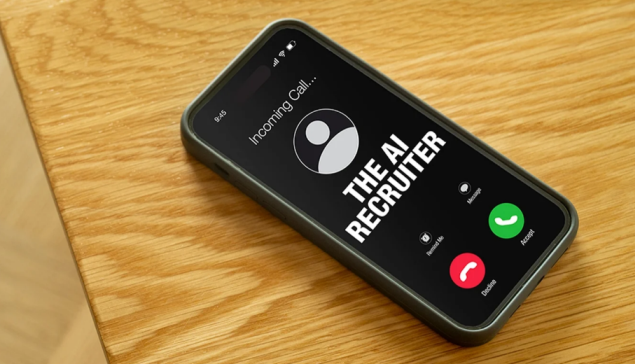
The voice on the phone wasn’t human. It got the hire anyway.
Published: 23.06.2026
Danny Romero, SIA
 Updated / 25th June 2026
The voice on the phone wasn’t human. It got the hire anyway.
A candidate’s profile had lain dormant in a staffing firm’s database for three years with no communication, having been overlooked by recruiters and no sign that he was still looking for a job.
One day, the candidate received an unexpected call. A friendly voice acknowledged it had been a while since they connected, asked about his interests and then spoke about a role that matched his experience. He accepted the placement.
No recruiter had searched the firm’s database, made the outreach or led the initial screening call for the candidate. It was all artificial intelligence.
The candidate was so impressed he emailed the staffing firm’s founder with praise about the experience.
The details of this hire, shared by the tool’s provider, ConverzAI, show how voice AI can work deeper across the recruitment funnel and identify candidates human recruiters hadn’t surfaced. And it goes the extra mile, handling personalized outreach, gauging interest and ultimately completing a placement.
Such capabilities are becoming more common as voice AI systems take on the nuts and bolts of the recruiting process.
“Humans are never going to pick up the phone and call 500,000 people just to find out the needles in the haystack,” says Pankaj Jindal, co-founder of Sense, a conversational voice AI recruiting tool.
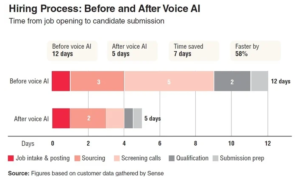
Voice AI can simultaneously engage large pools of candidates, screen them in real time and continuously re-rank them based on factors such as experience, compensation expectations and availability, Jindal says.
The technology can advance candidates from initial outreach to submission to a hiring manager with little or no recruiter involvement, he says. Firms can also choose to keep recruiters involved at various checkpoints throughout the process.
As voice AI has emerged in the staffing industry, it’s been viewed as a game changer for recruiters amid soaring applications that make manual screening less viable. The technology’s evolution is prompting staffing leaders to confront an urgent question: If AI can increasingly manage the front end of recruitment, what happens to recruiters?
The staffing industry was an early adopter of AI, and it’s easy to see why. Voice AI can work 24/7 and help scale a staffing business during periods of peak demand. As the technology improves, it’s becoming a deeper part of entire talent acquisition workflows.
Human Checkpoints
When ConverzAI founder and CEO Ashwarya Poddar launched the Redmond, Washington-based voice AI firm seven years ago, there was skepticism whether a candidate would talk to an automated voice on the phone.
“In the last two years, that has changed significantly,” Poddar says. “Now, that is not the question. The question is more about, ‘Hey, how best can you have the conversation with the candidate?’”
As the power of AI technology has ramped up, Poddar says the processing power in voice AI has improved, becoming cheaper to run and more effective. The largest value has come from screening, but “we will keep going deeper and deeper into the staffing functions.”
Even as voice AI grows more sophisticated, many staffing firms are wary of removing human recruiters entirely from the process.
Improvements in AI-powered staffing tech have enabled it to dig deeper and ask relevant follow-up questions, says Kim Ullstrup, product operations manager at Horizon Talent. This has been useful in determining candidates’ abilities and can also help flag fraudulent behavior. But her firm is proceeding cautiously, ensuring human oversight.
“You can’t let an AI recruiter handle something from start to finish, in my opinion,” she says. “While you can automate and use AI to get a lot of that initial top of the funnel screening done, you have to make sure that you have human checkpoints along the way.”
Sense’s Jindal describes voice AI as a new tool in a recruiter’s belt. “It’s not replacing a recruiter. What it’s doing is making them 30-40% more productive and taking away work that was completely repetitive.”
Deeper Connections
Implementing AI reduced job board spend by more than half at Integrity Staffing Solutions and brought the firm’s overseas recruiting spend to zero, CEO Jaime Donnelly says. But the more important development may be how voice AI can liberate a recruiter’s workload.
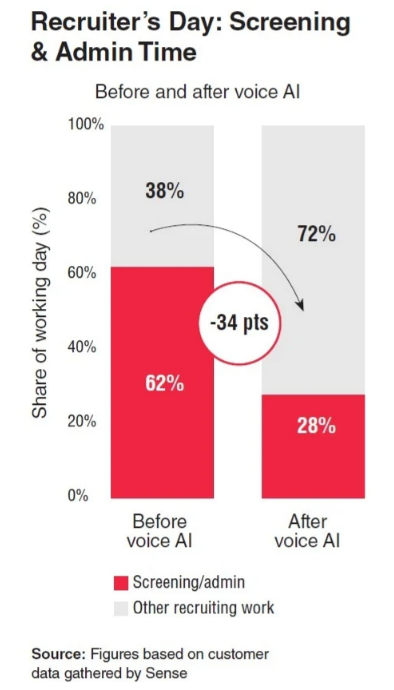
“We absolutely saw the role of the recruiter shift, and we had to be very intentional about what the recruiters were going to fill their time with if they weren’t doing all of the prescreens that they used to do,” Donnelly says.
Voice AI moved her team away from administrative work, which she calls the “abyss” of applicant tracking systems, to more meaningful interaction. The impact has been considerable: Integrity’s client Net Promoter Score jumped to 92 from 56 in a single year — a result, Donnelly says, of recruiters spending more time deepening connections with clients and candidates.
“We haven’t had to lay off any of our recruiters because of AI,” she adds, “but I haven’t had to hire any additional recruiters because of AI.”
The shift toward more meaningful recruiter interactions is coinciding with broader changes in candidate engagement driven by voice AI.
Better Engagement
Industry giant Adecco Group, which is trialing voice AI in the UK, is seeing most conversations happening outside of business hours, says Richard Horth, VP of UK delivery. That has led to “much quicker and better engagement because it’s available for when candidates want us.”
Does this mean the jobs of human recruiters are safe? It depends largely on what their role is in the workflow.
The personalized touch a human can offer will remain vital in certain circumstances, according to SIA’s Voice AI in Talent Acquisition report. “We still view perhaps the most vital step in the hiring process as being most conducive for human recruiters, closing the candidate to accept the job,” the report adds.
Regulation may also play a role against full-on AI adoption. Some markets have regulations requiring human oversight aimed at minimizing bias or errors, such as the European Union’s AI Act and New York City’s Local Law 144.
Human-tech collaboration can bring lasting benefits, says Mason Swofford, CEO and co-founder of Tenzo AI. The firm’s voice AI listens in on recruiter calls and offers real-time tips during their conversations.
On the client side, Swofford says Tenzo emphasizes more human recruiter involvement because “speed isn’t as important – quality is more important, the relationship’s more important.”
Integrity Staffing Solutions’ Donnelly is on the same page. “The human connection is still too important to our clients,” she says. But with the technology evolving, much wider adoption of AI is inevitable. “If we all stick our heads in the sand and assume that it’s just not going to happen, I think we’re being foolish.”
Jindal agrees voice AI doesn’t eliminate the need for recruiters but instead enables staffing firm growth and more potent human connection.
“They can now spend that time actually talking to candidates, actually talking to the customer … negotiating compensation — a lot of things that basically require humans,” he says. “[AI is] not here to replace people … it’s here to improve the margins of a staffing company because you can grow revenue without adding as much headcount.”
About the Employment & Recruitment Federation (ERF)
The Employment and Recruitment Federation is a voluntary organisation set up to establish and maintain standards and codes of practice for the recruitment industry. Representing over 200 member companies throughout Ireland, the ERF develops and promotes education and training and provides information and advice on the sector, as well as member services such as vetting and lobbying on policy and industry issues affecting the labour market.
For PR Information:
SHARON BANNERTON ¦ Managing Director, BANNERTON PR ¦ Mobile: + 353 87 673 1100 ¦ Email: Sharon@BANNERTON.ie